

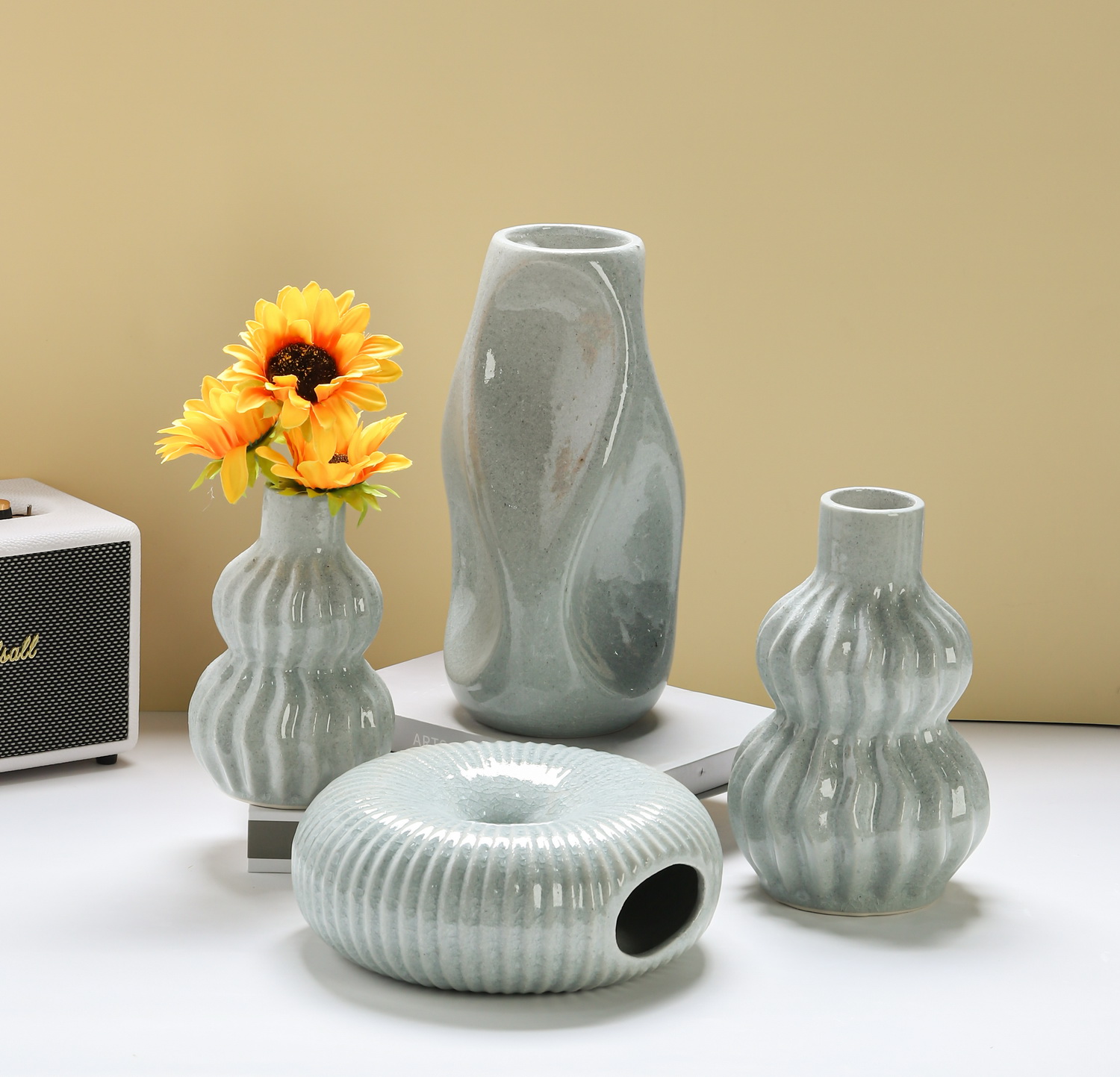
What a Mature Production Base Sees Earlier
As an American home decor designer, I can love a vase for its shape, color, or quiet sculptural detail.
But a buyer has to look deeper.
A buyer needs to know whether the product can be made, corrected, packed, shipped, displayed, and reordered without creating a chain of problems.
That is what a mature production base sees earlier. It sees the risks hiding behind a beautiful sample: a rim that may chip, a glaze that may shift, a base that may wobble, a carton that may fail, or a shape that looks good in a photo but becomes expensive in bulk production.
For ceramic decor wholesale, that early judgment can save the buyer time, money, and uncertainty.
A Decorative Vases Buying Guide Should Start With Risk
A practical decorative vases buying guide should not begin with “Is this vase pretty?”
It should begin with sourcing questions:
Can the material support the shape?
Can the glaze be repeated?
Will the rim survive handling?
Does the base sit flat?
Can the product be packed safely?
Can the approved sample become a stable production reference?
A strong ceramic vase manufacturer should help buyers answer these questions before the order is placed. A mature production base is useful because it has already seen many versions of the same problem.
Why Buyers Trust Grounded Production Answers
This is why buyers trust grounded production answers.
A weak supplier says, “Yes, we can make it.”
A stronger supplier says:
“This rim may need more thickness before shipment.”
“This matte finish may rub if the carton is too tight.”
“This glaze is attractive, but this version will repeat more safely.”
“This tall vase needs a wider base.”
“This size may affect carton cost and freight efficiency.”
Buyers trust answers like these because they sound grounded in real production experience. The supplier is not only selling a product. The supplier is helping the buyer avoid a preventable mistake.
Where Packaging Awareness Begins Before Shipping
This is where packaging awareness begins before shipping: not at the warehouse, but at the sample table.
A mature production base thinks about packaging when the product shape is still being reviewed.
Will the product move inside the carton?
Will the surface need separation?
Will the rim need extra support?
Will the carton protect the shape without destroying margin?
Will the same packaging method work for the reorder?
ISTA notes that most of its package testing protocols call for determining product damage tolerance and package degradation allowance before the test begins. For fragile home decor, that means buyers and suppliers should think about acceptable damage risk early, not after shipment problems appear.
How a Craft Region Shortens the Correction Cycle
This is how a craft region shortens the correction cycle.
In a mature craft region, the supplier is not guessing from one sample. The team has production memory from many products: glaze variation, firing issues, weak rims, unstable bases, surface rubbing, carton pressure, and reorder mismatch.
That memory helps the supplier correct faster.
Instead of taking three rounds to discover the issue, the workshop may say:
“The problem is not only the color. It is the firing result.”
“The base should be adjusted before production.”
“The surface looks good, but it needs better separation in packing.”
“This large version looks impressive, but the medium size is safer for the buyer’s assortment.”
That is where mature production becomes a sourcing advantage.
Why a Global Sourcing Partner China Should Offer More Than Price
A global sourcing partner China should not only compete on quotation.
The value should be better product judgment.
For home decor buyers, the supplier should help with:
sample review,
finish control,
packaging awareness,
material judgment,
production correction,
assortment fit,
and reorder planning.
Eric von Hippel’s research on “sticky information” explains why problem-solving knowledge is often difficult to move away from where the work actually happens. In home decor, that means useful knowledge about materials, forming, finishing, packing, and repeat production often lives close to the production base.
That is why buyers benefit from suppliers who can connect design intent with workshop reality.
Why Recent U.S. Trends Make Early Judgment More Important
Recent U.S. home design coverage from Spring 2026 High Point Market highlighted draped forms, artisanal textures, indoor-outdoor performance materials, coastal blues, maximalist detail, Southwest-inspired textures, menswear patterns, oversized scale, and nostalgia-influenced palettes.
These are useful trend signals for decorative vases and ceramic home decor.
But they also increase sourcing risk.
A sculptural vase may be harder to pack.
A tactile finish may be harder to repeat.
A larger scale may affect freight and carton structure.
A handmade-looking surface may need clearer acceptable variation.
TikTok and social platforms can move taste quickly, but they do not answer the buyer’s production questions.
Can this be made again?
Can it ship safely?
Can the finish stay controlled?
Can the supplier correct the problem quickly?
A mature production base helps answer those questions earlier.
What Buyers Should Ask a Ceramic Vase Manufacturer
Before sourcing decorative vases, buyers should ask:
What risks do you see in this shape?
Can this finish be repeated in bulk?
Does the base need adjustment?
What packaging risk should we discuss before production?
Can this item work as part of a small assortment?
How would you correct this sample?
Can the second order match the first approved sample?
A strong supplier should not only confirm what the buyer wants. It should help the buyer see what the buyer may have missed.
FAQ: What a Mature Production Base Sees Earlier
What does “what a mature production base sees earlier” mean?
It means an experienced production base can often identify material, finish, shape, packaging, and repeat-production risks before they become expensive buyer problems.
Why does this matter for ceramic decor wholesale?
Ceramic decor involves clay body, glaze, firing, surface finish, rim strength, base stability, packaging, and reorder consistency. Early risk detection helps buyers avoid costly corrections.
Where does packaging awareness begin before shipping?
Packaging awareness begins during product development and sample review. Buyers should consider shape, finish, rim strength, surface protection, carton structure, and shipping risk before production is finalized.
How does a craft region shorten the correction cycle?
A craft region shortens correction because local makers have repeated experience with similar materials, finishes, shapes, and packaging problems. They can often identify the cause faster.
What should buyers expect from a global sourcing partner in China?
Buyers should expect more than price. A strong sourcing partner should offer product judgment, sample correction, packaging awareness, finish control, and reorder support.
Final Thought: Mature Production Sees the Hidden Cost Early
A product photo creates interest.
A sample starts the conversation.
But mature production knowledge tells the buyer what may go wrong before the order becomes expensive.
That is what a mature production base sees earlier in B2B home decor sourcing. It sees material risk, finish risk, packaging risk, correction risk, and reorder risk before they become the buyer’s problem.
A good supplier makes products.
A mature production base helps buyers make better decisions.
Leave a Reply